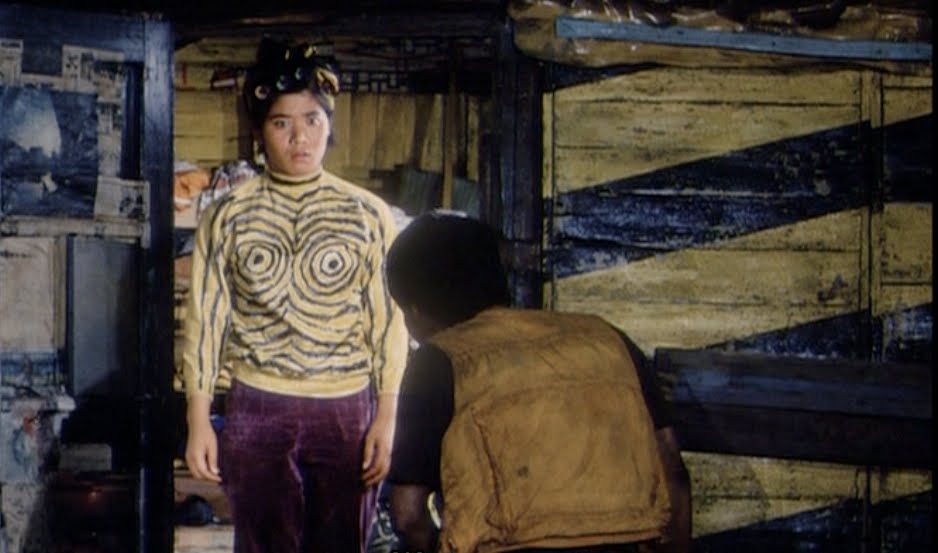
Matinee viewers, we are in for a voyage this week. Dodes'ka-Den, Akira Kurosawa's first color film, was made in frustrated response to Hollywood producers slamming his work on Tora!Tora!Tora! ---from which he was fired by Fox and at the same time, the Japanese film industry was in crisis (Prince). Back home in Tokyo, he started The Club of Four Knights with the three cool cat directors of Japanese cinema, Masaki Kobayashi, Kon Ichikawa and Keisuke Kinoshita---Dodes'ka-Den is their first and only film as the Club.
Dodes'ka-Den is onomatopoeia (yeah! how fun is onomatopoeia to say and write and alas, how rarely we do so?) for trolley sounds. And the trolley sounds and "conductor" link the diverse characters in this film. A series of vignettes in a slum outside Tokyo, based on a novel by Shugoro Yamamoto, Dodes'ka-Den is far out---more play, poem and moving art piece then linear story.
Although made in 1970, the wild use of color and backdrop preempt graffiti art and particularly, will have you mentally wandering in and out of Jean-Michel Basquiat's work (even though he wouldn't be creating for another decade) and theatre sets, of a surreal Beckett or Lorqa tableau.
Additionally, Kurosawa is in cahoots with some of the players--all are living a rough side of life but a few have brilliant imaginations (one tragically so) and Kurosawa allows for legit sound effects and visions to substantiate what the heroes are hearing, touching or drawing in their minds.
The prose riffs in the direction of the darker poems of Langston Hughes who often took snapshots of communities where people were down on their luck but built something, original and often beautiful.
The setting looks almost like an artist's view of a dump, with tiny box houses built around a color or mood trope. Each vignette is boxed in the little house or shelter occupied by the figures in that story, and they cross each other in the middle of larger community space---signified by the water pump. The pump is almost constantly under control of ladies that i am referring to as our Oracle, they comment and provide background as we wander in one vignette and into the next, like Rokkuchan and his imaginary trolleys--they are another seam in the story quilt.
Rokkuchan (Yoshitaka Zushi) is the "trolley" conductor.
The Yellow and Red Swingers provide both righteous arty color schemes and comic relief.
The Oracle:
A red shirted beauty regularly visits the oracle and shares...
Ocho and Mr. Hei (Hiroshi Akutagawa) struggle with damaged hearts.
Katsuko (Tomoko Yamakazi) gives the most painful story as she lives with her asshole uncle (Tatsuo Matsumura) who is abusive in myraid ways. She folds tissue flowers all day and night in gorgeous colors, and the one spot of life is the sake delivery guy.
Ryo (Shinsuke Minami) and his kids have a philosophical view on paternity.
Mr. Shima (Junzaburo Ben) and Mrs. Shima (Yuko Kusunoki) work through love, bad attitudes and general badassery.
Kid (Hiroyuki Kawase) and Dad (Noboru Mitani) were my favorite story. They live in an old car and while little one scrounges for food with pluck besting all les petites miserables, cerebral dad constructs their dream home in their collective imagination.
Mr. Tanba (Atsushi Watanabe) is really the sage of the community---and completely fearless.
This isn't a light matinee, dearest patrons, but it's a wild little masterpiece---many of the critics didn't get it when it first came out and Kurosawa allegedly took this rejection very much to heart. Now it's wildly debated whether tis' pure genius or the odd film in Kurosawa's righteous portfolio, yada yada--let the film snobs fight, i say! We shall have minds blown.
Dodes'ka-Den is a rare, weird beautiful piece--you literally wander in color and devastation, beauty and pain---and rare moments of hell yeah, well done.